
Our Framework for Compounding Organic Traffic
A predictable, structured execution timeline built to eliminate technical bottlenecks, target high-intent buyers, and scale revenue.
What Most Agencies Get Wrong About the Process
Most SEO providers treat search campaigns like an endless loop of random tasks—publishing isolated blog posts or running automated script changes without an actual long-term timeline. That approach burns your marketing capital without ever moving your bottom line.
True search dominance requires a repeatable, structured framework that uncovers deep-seated website weaknesses, prioritizes high-impact wins, and scales your traffic systematically. Here is exactly how we turn unpredictable search algorithm updates into your most dependable client acquisition loop.
SEO INSIGHT
Why Most Websites Fail to Rank on Google & AI Search
- Crawl Barriers: Code errors block search bots.
- Speed Penalties: Slow loading tanks visibility.
- Mobile Friction: Layouts break on smartphones.
- Intent Mismatch: Ignoring the user’s actual question.
- Semantic Ignorance: Lacking related concepts and depth.
- AI Incompatibility: Targetting text strings over concepts.
- Zero Differentiation: Publishing surface-level, rehashed insights.
- Lack of Proof: Missing real-world experience.
- AI Filter Food: Text easily summarized without attribution.
- Fragmented Setup: Treating services as standalone pages.
- Missing Context: Lacking supporting FAQs and guides.
- Weak Trust Signals: Failing to own the niche.
- High Bounce Rates: Users leaving due to confusion.
- Interruption Penalties: Aggressive, intrusive popups.
- Dead Ends: Weak navigation and missing CTAs.
- No Backlink Profile: Lacking trusted referral links.
- Invisible Reputation: Zero brand mentions or reviews.
- Low Credibility: Unverified author authority.
- No Schema Markup: Missing structured data for AI.
- Bad Answer Formatting: Lacking concise, extractable definitions.
- Vague Language: Missing clear entity relationships.
- Static Pages: Letting content rot over time.
- Irregular Audits: Ignoring compounding technical errors.
- Siloed Tasks: Publishing blogs without a system.
SEO Mistakes That Block Rankings
Most businesses don’t fail at SEO from a lack of effort—they fail from quiet, unnoticed mistakes. You can throw thousands of dollars at content and backlinks, but if your site has foundational flaws, Google and AI discovery engines will simply ignore you.
If your traffic has plateaued or dropped, it is almost always due to one of these nine silent killers:
- Poor Technical Structure
A beautiful layout cannot save a site that search bots cannot read. Backend errors frustrate both human users and algorithm crawlers.
- Crawl Blocks: Missing sitemaps, indexing conflicts, and broken links that hide your pages from Google.
- Speed Drags: Unoptimized code and bloated elements that trigger page-speed penalties.
- Targeting the Wrong Keywords
Chasing high-volume keywords just because they look good on paper is a trap. If a phrase does not align with your actual business goals, it wastes your budget.
- Vanity Metrics: Ranking for massive, generic terms that never turn visitors into paying customers.
- Over-Competition: Trying to fight multi-billion-dollar brands for broad keywords instead of targeting winnable, high-intent niches.
- Thin or Low-Value Content
Publishing content just to hit a word count or keep a schedule does more harm than good. Thin, repetitive pages actively pull down your entire site’s authority.
- Copycat Copy: Regurgitating surface-level information that offers zero unique value or original insight.
- Diluted Authority: Crowding your site with weak pages, making it harder for your best content to rank.
- Weak Internal Linking
Internal links are the highways search engines use to navigate your site. If your pages are isolated, Google cannot distribute authority to your most important landing pages.
- Siloed Content: Leaving high-value service pages disconnected from your supporting blog posts and resources.
- Wasted Potential: Failing to guide users and search bots naturally toward your primary conversion funnels.
- Ignoring Search Intent
You cannot force a hard-sell sales page to rank for someone who is just looking for a basic, informational tutorial.
- Intent Mismatch: Offering a product pitch when the searcher wants a guide, causing immediate bounces.
- Algorithmic Rejection: Mismatching user expectations, signaling to Google that your page is irrelevant.
- Over-Optimization
Clinging to outdated strategies like forcing exact keywords into every paragraph makes your site look manipulative, not authoritative.
- Keyword Stuffing: Ruining readability by aggressively repeating phrases to trigger old algorithm rules.
- Unnatural Code: Over-engineering meta tags and anchor text until your site reads like a robot wrote it.
- Poor Mobile Experience
Google uses mobile-first indexing. If your website lags, glitches, or feels clunky on a smartphone, your desktop rankings will tank alongside your mobile ones.
- Responsive Flaws: Text that runs off the screen, tiny tap targets, and intrusive popups that break mobile layouts.
- Mobile Speed Drops: Forcing mobile users to download heavy asset files meant only for high-speed desktop connections.
- Lack of Authority Signals
Even a flawless website will sit invisible in a competitive market if nobody else on the web vouches for your brand.
- Ghost Profile: Operating with zero trusted external backlinks, digital press mentions, or industry citations.
- Missing Reviews: Lacking verified customer feedback and digital trust footprints across the web.
- No SEO Maintenance Strategy
Treating search optimization like a one-time project is a recipe for steady traffic decay. Competitors adapt, code degrades, and algorithms change daily.
- Static Stagnation: Letting content rot for years while your rivals publish updated, more accurate information.
- Accumulated Errors: Allowing broken links and technical script errors to quietly pile up over time without audits.
The Bottom Line
Fixing your rankings is rarely about discovering a single magic trick. It requires systematically wiping out these overlapping strategic flaws. The brands that dominate search engines and AI answers are the ones that actively audit their technical health, respect user intent, and build actual web authority.
Why Technical SEO Still Matters
- Crawl Bottlenecks: Redirect loops, duplicate content, and messy canonical links waste your site’s crawl budget.
- Indexing Blockers: Accidental crawl blocks, broken sitemaps, and orphaned pages keep valuable service pages invisible.
- Performance Optimization: Tweaking server response times, asset compression, and site caching solves lag.
- Core Web Vitals: Polishing backend rendering speeds ensures your page loads instantly on all connections.
- Layout Stability: Fixing shifting elements ensures text scaling is perfectly readable on small devices.
- Touch Usability: Optimizing tap targets, button spacing, and navigation prevents user frustration.
- HTTPS Enforcement: Installing SSL certificates to encrypt data and eliminate “Not Secure” browser warnings.
- Mixed Content Fixes: Eliminating hidden HTTP resources on secure HTTPS pages that cause security lapses.
- Rich Snippets: Implementing Schema code to win star ratings, recipe cards, and FAQ layouts on search result pages.
- AI Engine Readiness: Formatting data so large language models can easily parse, credit, and cite your site as a trusted source.
- Internal Linking: Building clear paths from high-authority pages to new content to accelerate indexing.
- URL Hygiene: Utilizing short, lowercase, and descriptive URL paths that reflect your actual site hierarchy.
Homepage Optimization & SEO Structure Improvement
Your homepage is the absolute anchor of your entire SEO ecosystem. It carries the most backlink authority, commands the highest traffic, and serves as Google’s primary baseline for judging your brand. If your homepage is vaguely written or structurally chaotic, it actively drags down the ranking power of every single subpage on your domain.
True homepage optimization balances high-end design with strict algorithmic architecture, proving your commercial relevance to both human buyers and search crawlers.
- Establishing Immediate Search Relevance
A beautiful homepage is useless if visitors and bots have to guess what you actually sell. Modern search engines demand rapid contextual clarity the moment they hit your main URL.
- Core Visibility: Stating your primary services, ideal target audience, and geographic focus above the fold.
- Contextual Framing: Eliminating generic, hype-filled corporate fluff in favor of specific, search-friendly industry definitions.
- Distributing Power via Site Architecture
Your homepage acts as a central power generator. It must strategically push its massive accumulated authority down into your deeper, more profitable service silos.
- Crawl Pathways: Building clean navigation tracks that guide search bots to high-priority landing pages.
- Authority Flow: Eradicating dead ends and weak linking structures that cause deeper pages to stay unindexed.
- Tightening Content Hierarchy
Search algorithms use header tags to parse what your business actually does. A chaotic layout with random formatting signals structural weakness.
- Semantic Tagging: Implementing a single, keyword-optimized H1 heading supported by logical H2 and H3 subheadings.
- Scannable Blocks: Mapping out clear content sections dedicated to specific service buckets and trust signals.
- Maximizing Conversion Pathways
Traffic is just a vanity metric if your homepage fails to capture leads. Your SEO structure must seamlessly transition search traffic into active business inquiries.
- Frictionless CTAs: Placing prominent, high-contrast buttons at strategic scrolling intervals.
- Trust Injection: Anchoring your conversion forms next to reviews, case studies, and corporate credentials to reduce buyer hesitation.
- Executing Technical Optimization
Because your homepage handles the highest traffic load, technical imperfections here have devastating, site-wide consequences.
- Vital Benchmarks: Stripping out heavy unoptimized assets to pass Google’s strict Core Web Vitals.
- Structural Safety: Ensuring flawless mobile responsiveness and zero code bloat to guarantee fast rendering on all devices.
- Optimizing for AI Engine Discovery
AI search platforms treat your homepage as the ultimate brand reference hub. If your data isn’t structured cleanly, AI summaries will misrepresent or bypass your business entirely.
- Schema Blueprinting: Injecting organization and local business schema so AI platforms can extract facts instantly.
- Entity Definition: Using crisp, definitive language that allows AI language models to accurately categorize your brand’s niche.
The Bottom Line
Your homepage is not just a digital welcome mat—it is a functional blueprint for your entire search strategy. By transforming it into a high-performance hub of technical health, logical site architecture, and crystal-clear service relevance, you unlock compounding traffic and revenue growth across your entire web domain.
Website Audit Breakdown
You cannot fix what you don’t measure.
Guessing your way through an SEO strategy wastes time and budget. Before you can dominate search results, you must uncover the hidden technical bottlenecks, content gaps, and structural flaws that are quietly dragging down your visibility.
Our website audit is a comprehensive diagnostic deep-dive that strips away the guesswork, revealing exactly why your site is lagging and delivering a clear, data-driven blueprint for compounding traffic growth.
- Technical SEO Audit
Hidden backend bugs are the ultimate ranking killers. If search crawlers cannot easily access and parse your site’s code, your content will never see the light of day.
- Crawl & Index Verification: Pinpointing redirect loops, sitemap errors, broken links, and hidden blocks inside your robots.txt file.
- Core Web Vitals: Slashing page-load lag and optimizing image assets to pass Google’s strict site-speed benchmarks.
- Mobile Compliance: Verifying responsive layouts and checking for mobile-specific technical friction.
- On-Page SEO Audit
On-page optimization dictates how easily search engines can figure out what your pages mean and how likely they are to display them to buyers.
- HTML Component Review: Overhauling broken tag structures, title elements, and meta descriptions to drive higher click-through rates.
- Semantic Tuning: Analyzing your internal linking architecture, URL configurations, and keyword placement to ensure your pages look highly relevant.
- Content Quality Audit
The internet is flooded with copycat content. We grade your entire text asset library to ensure your pages add unique value and support your commercial goals.
- Fluff Elimination: Identifying thin, repetitive, or outdated pages that are actively diluting your site’s domain authority.
- Intent Calibration: Checking your content depth against the actual search intent of your high-value target keywords.
- Website Structure & UX Audit
A chaotic website layout confuses both human visitors and search engine bots, destroying your conversion rates and dropping your rankings.
- Authority Flow Architecture: Designing clean navigation hierarchies that automatically push ranking power straight to your primary sales landing pages.
- Conversion Optimization: Evaluating mobile layouts and user pathways to keep prospects on-site longer and eliminate friction points.
- Competitor Benchmark Analysis
Your search performance does not exist in a vacuum. We reverse-engineer your closest competitors’ strategies to find the exact gaps you can exploit.
- Keyword Gap Discovery: Finding the high-traffic commercial terms your competitors rank for that your site is completely missing.
- Authority Benchmarking: Evaluating rival technical frameworks and backlink portfolios to prioritize your fastest path to outranking them.
- Backlink Profile Review
High-quality external links act as digital votes of confidence. We analyze your link footprint to protect your site from algorithmic penalties and boost your authority.
- Risk Mitigation: Identifying and disavowing toxic, low-quality backlinks that could trigger a sudden search engine penalty.
- Link Profile Expansion: Auditing anchor text distribution and referring domain diversity to build a natural, commanding link profile.
- AI Search Readiness Assessment
Modern search engines do not just read keywords—they extract data to answer conversational queries. We prepare your site for the future of zero-click answer engines.
- Machine Clarity: Reviewing your advanced schema markup and semantic HTML tags so AI systems can easily parse your core business entities.
- Data Extractability: Structuring your content layouts so AI summaries can effortlessly pull out and cite your business data.
The Bottom Line
An SEO audit is not a generic automated checklist—it is a customized commercial roadmap. By thoroughly analyzing your technical foundations, content quality, link authority, and AI readiness, we isolate the exact blocks choking your traffic. You stop wasting resources on guesswork and start executing a clear plan built for long-term growth.
What Google and AI Look for in Modern Websites
Search algorithms no longer just match keywords—they judge entire digital ecosystems.
Modern discovery networks blend technical excellence, user psychology, semantic analysis, and trust verification to rank your business.
To win today, your website must serve two masters simultaneously: the human buyers looking for answers and the AI engines extracting data behind the scenes.
- Technical Performance & Accessibility
If your backend is broken, your content stays invisible. Google and AI crawlers immediately penalize websites that force them to waste processing power on sloppy code.
- Crawl Efficiency: Streamlining server response times and stripping out code bloat so bots index your pages instantly.
- Core Web Vitals: Delivering light speed load times, airtight HTTPS encryption, and perfect mobile rendering.
- Semantic Organization & Site Structure
Clarity is the ultimate ranking currency. Modern search engines reward logical, neatly structured page blueprints that prove your website knows how topics connect.
- Data Scannability: Organizing your pages with explicit HTML heading hierarchies (H1 to H3 tags).
- Topic Maps: Connecting your service pages and blog posts through deliberate, strategic internal links.
- High-Quality, Intent-Driven Content
The modern search landscape rewards deep value, not high content volume. Generic, copycat pages get filtered out of search results completely.
- Intent Alignment: Matching your page layout perfectly to what the user wants to accomplish (buying, learning, or comparing).
- Topical Exhaustiveness: Writing clear, comprehensive copy that completely resolves a searcher’s problem in one visit.
- Topical Authority Hubs
You cannot rank for competitive commercial terms with isolated pages. Algorithms evaluate whether your brand owns the broader conversation around your niche.
- Content Clusters: Building interconnected silos of service pages, supporting guides, and deep-dive technical resources.
- FAQ Ecosystems: Creating comprehensive question-and-answer databases to capture broad conversational searches.
- Verified Trust & Credibility Signals
Trust is the hardest metric to fake, and it is exactly what modern search engines look for first. Algorithms demand proof that your company is a legitimate authority.
- External Footprints: Earning high-quality backlinks, unlinked brand mentions, and media citations across reputable sites.
- Reputation Capital: Maintaining consistent business data, transparent corporate details, and verified customer reviews.
- Seamless User Experience (UX) Behavioral Signals
SEO and user behavior are permanently joined. If your site’s interface drives users away, algorithms recognize those friction signals and drop your rankings.
- Engagement Depth: Keeping users on your site longer through clean layouts, fast navigation, and clear font choices.
- Friction Removal: Eliminating aggressive popups, broken mobile targets, and confusing conversion paths.
- Structured Data & Machine Readability
AI systems do not read text like humans do; they parse data points. Explicitly labeling your information helps AI engines confidently index your business details.
- Schema Blueprints: Embedding advanced organization, service, location, and review schema directly into your code.
- Rich Snippets: Transforming raw text into machine-readable data strings to capture enhanced Google search real estate.
- Content Extractability for AI Search
As zero-click searches and AI Overviews take over, your text must be easy for machines to quote, summarize, and reference in real-time conversations.
- Snippet Optimization: Crafting concise, direct data points and answers that AI tools can easily lift.
- Logical Formatting: Chunking long descriptions into clear, scannable, and programmatically friendly blocks.
The Bottom Line
Winning the search game today means abandoning the one-dimensional checklists of the past. The websites dominating modern search networks are fast, trustworthy, semantically clear, and built directly for the intersection of human usability and AI interpretation.
Slow pages, broken structures, and indexing errors will quietly kill your organic growth. Even the best content fails if search engines find broken paths or slow pages.
We handle all the technical architecture, cleanup, and speed upgrades behind the scenes so your site can reach its full ranking potential.
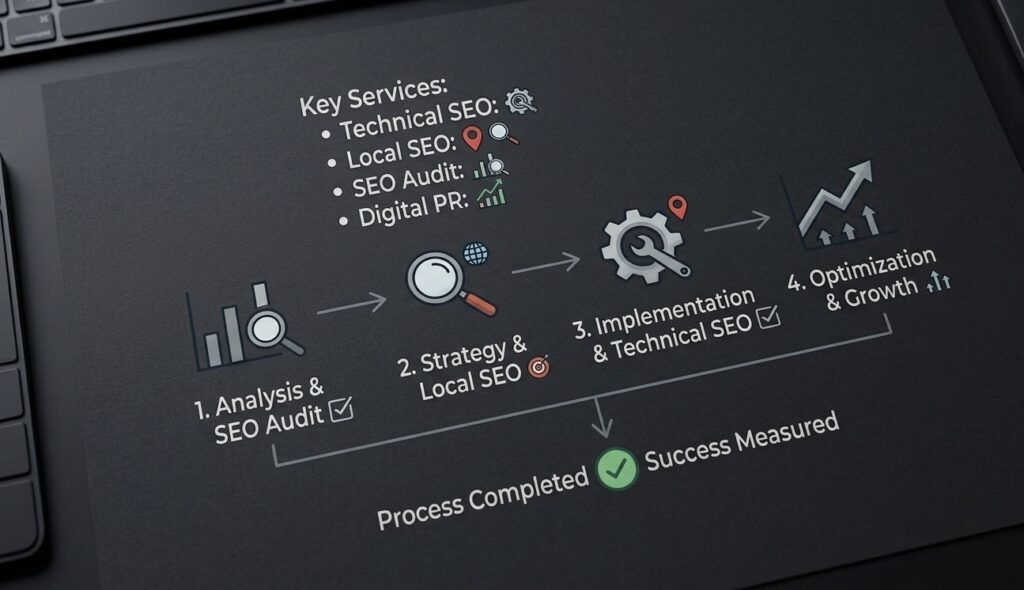
Stage 1 — Month 1: Forensic SEO Analysis
Before we touch a single line of code or optimize a headline, we diagnose exactly what is currently holding your website back and map out your competitors’ traffic playbooks.
Stage 2 — Month 1 to 2: Customized Strategy Development
Before we touch a single line of code or optimize a headline, we diagnose exactly what is currently holding your website back and map out your competitors’ traffic playbooks.
Stage 3 — Month 2 and Beyond
Continuous Execution & Optimization
With the strategy locked down, we transform planning into tangible code adjustments and content changes, making your site flawless for both human visitors and machine-driven discovery systems.
Stage 4 — Ongoing: Performance Monitoring & Authority Building
SEO is a dynamic process, not a one-time setup. We relentlessly analyze live data signals to protect your ranking momentum, pivot around algorithm updates, and expand your digital footprint.
Ready To Uncover Your Search Growth Opportunities?
Schedule a direct review and discover the technical issues, content gaps, and ranking opportunities holding your website back.
Process Specifications FAQ
How much time do you need from my team during this process?
Very little. We handle the heavy lifting. During Month 1, we will need brief context on your commercial goals and secure view-only permissions for your site analytics. Once execution begins, we work independently or coordinate directly with your developer so you can focus entirely on running your business.
Why does the process take 2 to 3 months to show meaningful traffic growth?
Search engine spiders do not re-index the entire internet instantly. When we fix backend code or sharpen content, it takes time for Google and AI engines to discover the updates, crawl the modifications, recalculate authority signals, and adjust search positions. Technical improvements compound over time and often produce long-term organic returns.
Do you lock us into a strict, multi-month contract?
No. We operate entirely on a flexible month-to-month basis. If you feel we are not the right fit for your growth goals, you may pause or cancel your campaign with simple notice. We believe client retention should be earned through measurable value, not contractual restrictions.
How much access or administrative login permission do you need from us?
To implement technical adjustments efficiently, we typically require administrative access to your CMS platform and Google Search Console. If your organization maintains strict security controls, we can provide implementation instructions or code packages directly to your developer instead.
What happens if our organic search traffic does not improve right away?
Organic growth is a compounding process rather than an instant switch. If certain keywords or pages move slower than expected, we perform comparative analysis against leading competitors and refine the strategy by strengthening authority signals, improving content depth, and resolving newly identified technical limitations.
How do we know you aren't just using automated bots to do the work?
Automated SEO software can only identify surface-level issues. Every technical review, outreach campaign, content structure adjustment, and optimization recommendation is completed manually by experienced specialists. We maintain transparency by documenting completed work and providing detailed reporting throughout the engagement.